
India Welcomes Top Foreign Universities Under New UGC Framework
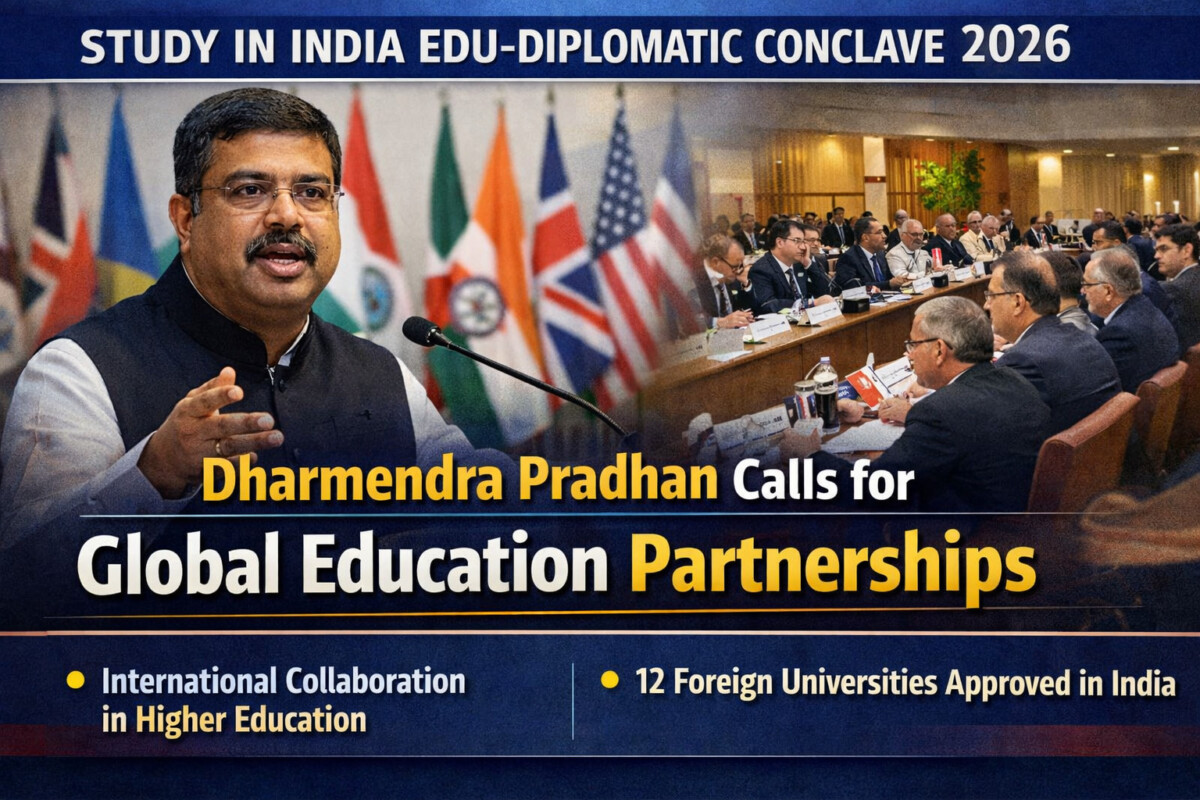
India welcomes top foreign universities under the new UGC regulatory framework, with 12 global institutions approved to establish campuses across major cities from the 2026–27 academic session, strengthening India’s position as a global education hub.
Dharmendra Pradhan Calls for Stronger Global Education Partnerships at Study in India Conclave
At the Study in India Edu-Diplomatic Conclave 2026, Union Education Minister Dharmendra Pradhan pitched for deeper international collaborations in higher education, emphasizing that India’s greatest strength lies in its “vibrant knowledge ecosystem, demographic dividend and fast-growing economy.”
Addressing ambassadors, high commissioners and diplomats from over 50 countries at Sushma Swaraj Bhawan, the Minister stated that “education remains the most enduring bridge between societies in a world marked by uncertainty and rapid change.” He invited global institutions to collaborate with India’s innovation-driven and multidisciplinary higher education system.
NEP 2020 Driving Internationalisation
Highlighting the transformative impact of National Education Policy 2020, Pradhan said India has made significant strides in quality enhancement, innovation, and affordability in higher education. He reiterated Prime Minister Narendra Modi’s vision of making India a developed nation by 2047, the centenary year of Independence.
Through initiatives like Study in India, the government is creating global pathways for students, researchers, and institutions. The Minister noted that India is emerging as a trusted innovation partner in areas such as artificial intelligence, biotechnology, semiconductors, and sustainable energy.
“India invites the world to study, innovate and grow together,” he said, urging diplomats to deepen partnerships with Indian universities.
UGC’s Fast-Track Framework for Foreign Universities
Secretary, Higher Education, Vineet Joshi, highlighted that reforms under NEP 2020 have strengthened multidisciplinary education and global engagement. He noted that the University Grants Commission (UGC) has introduced a transparent and time-bound regulatory framework allowing foreign universities to establish campuses in India under 2023 regulations.
Applications from leading institutions across Australia, Italy, the United Kingdom and the United States have been processed within a month, reflecting India’s reform-oriented approach.
Foreign Universities Expanding Footprint in India
India’s ambition to host globally ranked universities gained momentum in 2025, with 12 foreign institutions receiving Letters of Intent (LoIs) to establish campuses across major cities.
Approved institutions include:
Victoria University – Delhi NCR
Western Sydney University – Greater Noida
University of Liverpool – Bengaluru
La Trobe University – Bengaluru
University of York – Mumbai
University of Aberdeen – Mumbai
University of Bristol – Mumbai
Istituto Europeo di Design – Mumbai
Illinois Institute of Technology – Mumbai
University of Western Australia – Mumbai & Chennai
However, most of these campuses are expected to begin student intake from the 2026–27 academic cycle, with operational rollout still underway.
Currently Operational Foreign Campuses in India
As of early 2026, only three foreign universities are fully operational in India:
Deakin University – GIFT City, Gujarat
University of Wollongong – GIFT City, Gujarat
University of Southampton – Gurugram, Delhi NCR
These campuses represent the first phase of India’s global higher education integration under the new regulatory framework.
A Strategic Shift in Global Education Diplomacy
The conclave featured discussions on Indian Knowledge Systems, SPARC and GIAN academic partnerships, artificial intelligence, advanced technologies, skill internationalisation, and Bharat Innovates 2026.
The Study in India Edu-Diplomatic Conclave 2026 reaffirmed India’s position as a rising global education hub. With progressive reforms, international collaboration frameworks, and demographic strength, India is positioning itself not just as a destination for learning — but as a global partner in knowledge creation.