
CUET UG 2026 Exam Begins From May 11; NTA Issues Dress Code, Exam-Day Guidelines
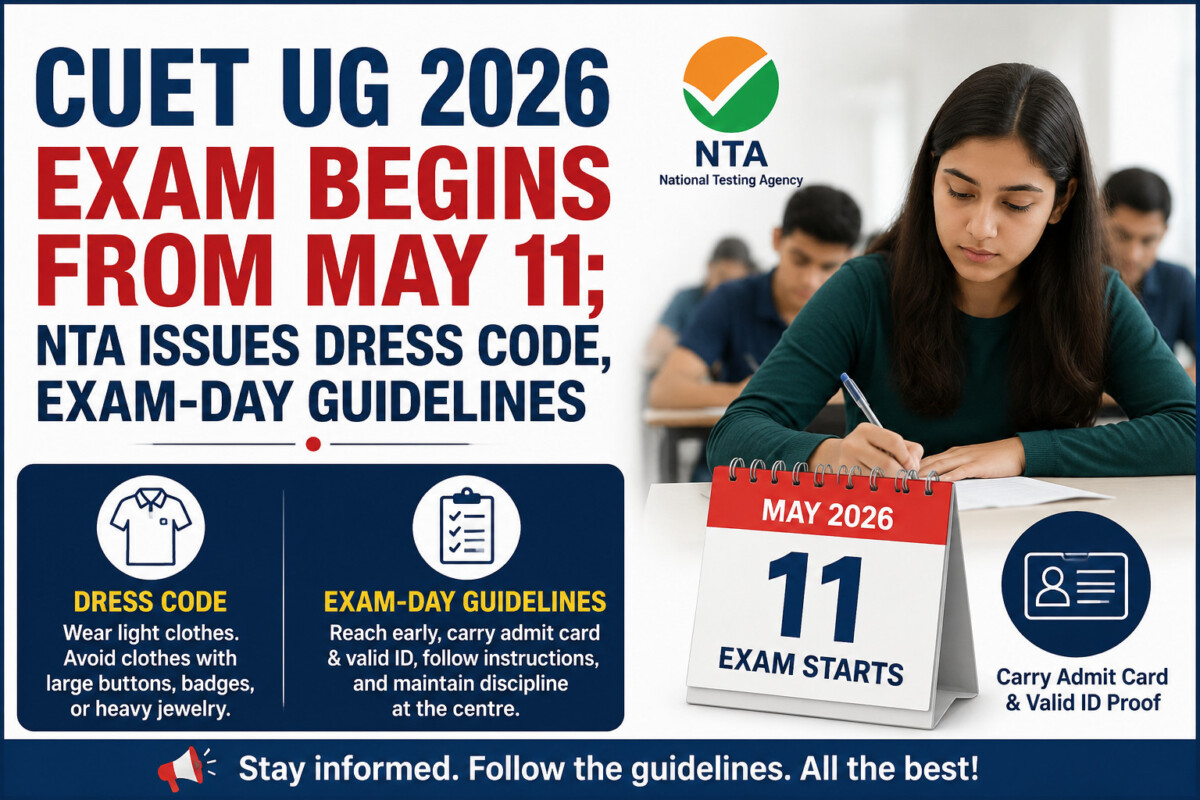
The National Testing Agency (NTA) has released important guidelines for candidates appearing in the Common University Entrance Test Undergraduate (CUET UG) 2026, scheduled to begin from May 11, 2026. The examination will be conducted in Computer-Based Test (CBT) mode across centres in India and selected international cities.
According to the advisory, candidates must strictly follow the prescribed dress code and examination instructions to avoid inconvenience during entry and security verification. Students have been advised to wear light-coloured clothes with half sleeves and avoid heavy garments, metallic items, brooches, badges, or clothes with large pockets. Slippers and sandals with low heels are preferred, while shoes with thick soles and high heels should be avoided.
The NTA has also clarified that candidates wearing customary or religious attire such as hijab, turban, religious threads, or similar items will be permitted. However, such candidates should report early at the examination centre to allow sufficient time for additional security checks.
Candidates are allowed to carry only essential items inside the exam hall, including:
- CUET UG 2026 admit card
- Valid photo identity proof
- Passport-size photographs
- Transparent water bottle
Electronic gadgets such as mobile phones, smart watches, calculators, Bluetooth devices, earphones, and other communication devices are strictly prohibited inside the examination hall.
The agency has instructed candidates to reach their examination centres at least two hours before the commencement of the exam. Entry gates will close 30 minutes before the scheduled start time, and no candidate will be allowed entry after the gates are closed.
Students have also been advised to carefully read all instructions mentioned on their admit cards and follow the seating arrangements and examination protocols properly.
CUET UG 2026 is one of the country’s largest undergraduate entrance examinations and serves as a gateway for admission to central universities, state universities, deemed universities, and other participating institutions, including Jawaharlal Nehru University (JNU) and Banaras Hindu University (BHU).